

Why Willpower Isn't Enough (And What I'm Trying Instead)
The tools I use to tackle the subconscious beliefs that get in the way of making and sharing my artwork
This article contains affiliate links. If you purchase through them, I may earn a small commission at no extra cost to you. I only include affiliate links for things I have genuinely used and think are beneficial.
Visibility can be one of the hardest things about being an artist. Not the making — the being seen. And if, like me, being seen has historically felt unsafe, then putting your work into the world takes a lot more than courage. It takes some serious work on what’s going on underneath.
In this article I’m sharing the practical tools I’ve been using to shift my mindset — not the motivational-poster kind of mindset work, but the deeper, quieter kind that targets subconscious beliefs. I hope something here is useful to you too.
Where I am currently (for context)
In 2026 it already feels like I’ve made more progress than the last two years combined — even if it still feels glacial at times.
I started my Substack last year as a low-friction way to have a newsletter, and this year I’ve posted 24 articles, most of them illustrated. The illustrated characters I’ve been creating are helping me hone my character development and style, as well as work through ideas. It’s often felt exposing — starting was genuinely hard.
In March I published my website — still a work in progress, but the bones are there and it feels like a real statement of taking myself seriously as an artist. I’ve also set up Pinterest, and post fairly regularly on Instagram (though ‘regularly’ and ‘consistently’ remain two different things for me!).
This all feels significant. I have a job, other commitments, and a nervous system that has historically tried to protect me from visibility — because for a long time, being seen meant being bullied. So progress, however incremental, counts.
The background: why subconscious work matters
I’ve had counselling and therapy off and on for years — person-centred, psychodynamic, a bit of CBT. All of it helped to a degree, and I’m genuinely grateful to the people who supported me. But insight, I found, doesn’t automatically equal change.
When I worked in admin for a CBT-based therapy service, practitioners often lamented that they couldn’t get to clients’ core beliefs because sessions weren’t long or deep enough. That made intuitive sense to me. And later, while working for a hospice counselling service, a colleague — Hazel* — rather casually mentioned EMDR (Eye Movement Desensitisation and Reprocessing): “It gets right down to the core issues without weeks and weeks of counselling.”
I didn’t end up having EMDR at the time (although I have just recently started), but that conversation was the catalyst for a shift in how I think about this. If experiences that happened before we had words to describe them need non-verbal approaches to heal — then talk therapy, cognitive approaches, or forcing myself into action by sheer willpower won’t cut it. The work has to happen at the subconscious level.
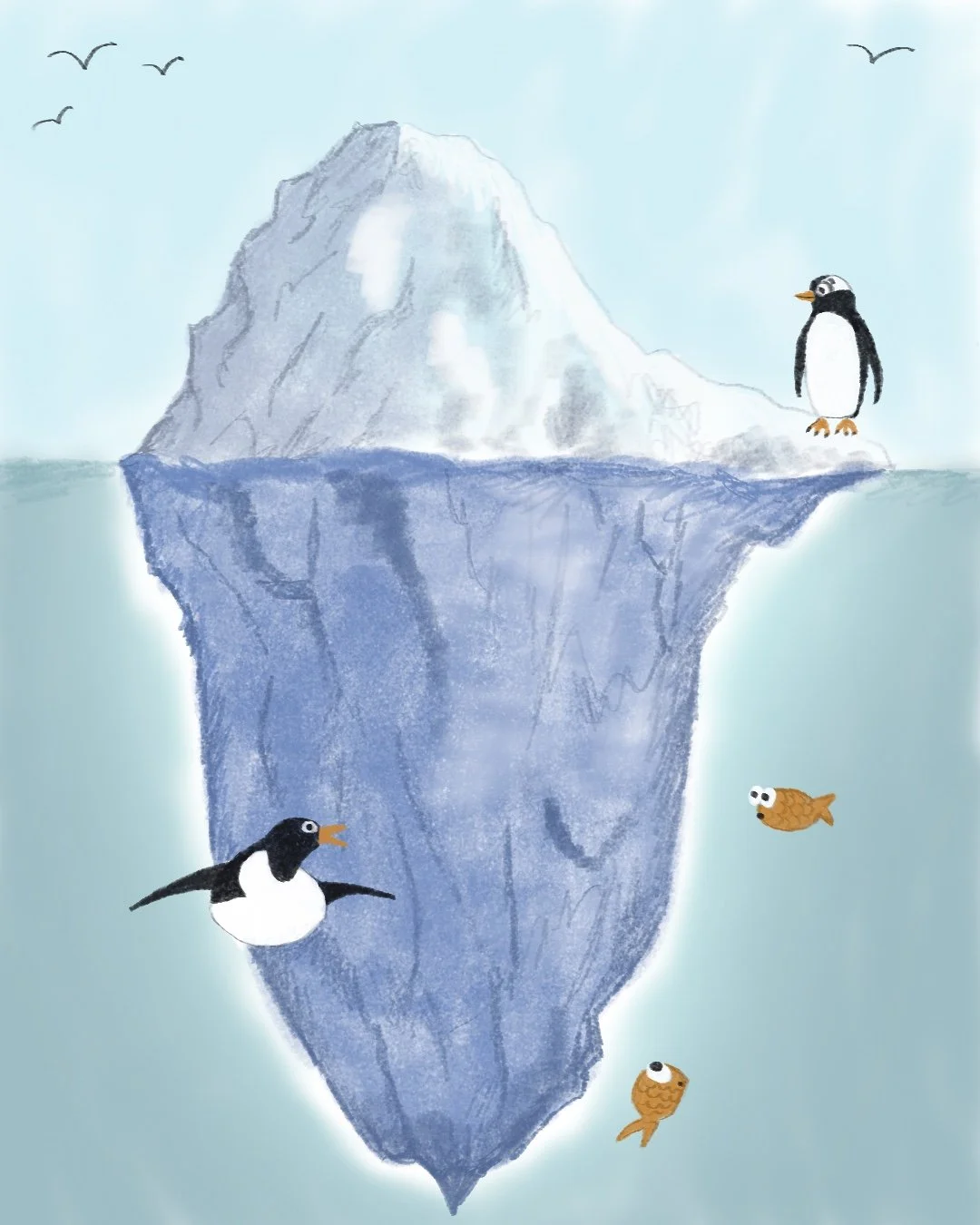
The old subconscious mind as an iceberg cliche…
What I’m trying
Self-Hypnosis
Self-hypnosis is a self-induced trance state that allows you to use suggestions or intentions to shift focus, challenge old patterns, and access the subconscious mind — essentially bypassing the conscious mind that spends most of its time trying to keep you ‘safe’ (read: stuck).
I listen to recorded tracks by therapists to guide me in — so it’s not entirely self-led, but it’s flexible, affordable, and easy to do before sleep. It’s much cheaper than seeing a hypnotherapist in person, though if you have a deeply ingrained issue, face-to-face sessions could be well worth it.
I use Hypnosis Downloads, which has an extensive library of tracks and more comprehensive courses on depression and anxiety.
Internal Family Systems
IFS is a psychotherapy that believes our minds are naturally composed of multiple sub-personalities called ‘parts’ and an undamaged, compassionate core ‘self’. (I’ve touched on this briefly in my previous article Meet the Animals of Lantern Wood and plan further articles explaining it a bit further).
IFS therapy helps you access your Self to unburden and heal conflicting inner parts. It is an evidence-based practice highly effective for trauma, anxiety, depression, and inner conflict. Because I’ve had years of therapy I’m comfortable accessing the self-guided learning at the moment, but I’d encourage anyone who is in psychological distress and unfamiliar with therapy to access support from a trained practitioner.
Human Design
I came across Human Design by accident and would normally dismiss this sort of thing — but something about it resonated. The premise is that everyone has a different energy blueprint based on the time and place of their birth, drawing on astrology, the Chinese I Ching, and Kabbalah to suggest how different people are wired to work, make decisions, and communicate.
It’s too complex to summarise fully here, but in practice: based on my type, I’m experimenting with working differently — accepting that I’m not built to be consistently ‘always on and working’ — and learning to trust my bodily emotional responses rather than my head when making decisions. Both have been quietly revelatory.
https://ahumandesign.com/human-design-chart/
Art as Therapy
Having trained in Art Therapy, I’m hardly going to ignore this one. I’m obviously not doing psychotherapy on myself — but I am drawing on art therapy principles: making imagery of my shadow aspects, externalising things that are hard to put into words, using the process rather than the outcome as the point.
One important distinction worth making: if you’re doing self-led creative activities, or even art activities facilitated by someone else, that is art as therapy — not Art Therapy. Art Therapy (or Art Psychotherapy) can only be facilitated by a trained, HCPC-registered therapist. It can be particularly powerful if you want to explore unconscious beliefs, or if difficult things happened before you had the language to describe them. If that sounds relevant to you, www.baat.org is a good place to start.
EMDR
As mentioned above, I learned about this about 7 years ago but I never got round to exploring it further - I presumed it was only for people with trauma which I didn’t think I had (now I know differently), plus there was the cost factor. EMDR is a structured psychotherapy that helps people process and recover from traumatic events or life stressors. It utilises ‘bilateral stimulation’ - things such as such as side-to-side eye movements, auditory tones, or tapping. This process helps your brain re-evaluate distressing memories, reducing their emotional intensity and allowing you to replace negative beliefs with positive, adaptive ones.
Hopefully I can give a round up of if I feel it’s helped further down the line… Studies of it are encouraging and I’m also really interested in how it is combined with Art Therapy (another therapy that can work with pre-verbal experiences).
A note on timelines
None of these are wonder cures, and none of them work overnight. Many of us carry years — sometimes decades — of experiences that have left their mark: beliefs formed very young, wired deep into the brain. It’s realistic to expect that shifting them will take time.
But they do shift. That’s the point. Here’s to healing slowly and steadily. ♥
I’d love to know — have any of these tools resonated with you? Or are there other approaches you’ve found helpful? Share in the comments below.
* Hazel was a dear colleague to all of us at St Ann’s Hospice, and she died in 2021. I never got to tell her how much that conversation changed things for me.