

The Trauma Behind Making Art — and Sabotaging It
What the Animals of Lantern Wood Are Actually About
I’ve recently written introducing my little world of characters in Lantern Wood, and also about why sometimes ‘just do it’ isn’t always possible in creative ventures and achieving goals.
There’s a particular kind of pause that happens right before you post something you’ve made. Your finger hovering over the button. Caption written, deleted, rewritten. And then — nothing. Not writer’s block, not laziness. Just stuck, in a way that doesn’t respond to deadlines or pep talks.
Maybe you know this one too: the idea you talked yourself out of before you’d even properly looked at it. The finished piece you show to five different people, hoping one of them will finally give you permission to believe it’s good. The new medium, the new course, the new “just one more thing to learn first” that appears exactly when the actual work gets close to being seen. Pushing yourself hard to make and achieve — and then, right at the point of sharing it, going quiet.
I used to call this a lot of things. Perfectionism. Overthinking. Just being wired a certain way. What I was reluctant to name, for a long time, was trauma.
I’ll be honest about why. Trauma is having something of a moment at the minute — everyone seems to have it, in every conversation, to the point where the word risks becoming background noise, shorthand, occasionally even a punchline about a generation who supposedly can’t handle being disagreed with. And I’m Gen X (yes, that old!). Where I come from, trauma was surviving a car accident, or a war zone. Not a difficult childhood or being bullied. Not this.
But here’s what I’ve finally come to understand about trauma: trauma can be extreme and ongoing stress experienced by a child that overwhelms their ability to cope - think abuse, parental neglect, abandonment and/or inconsistent and volatile parenting i.e. the parent was both the source of fear and of love.
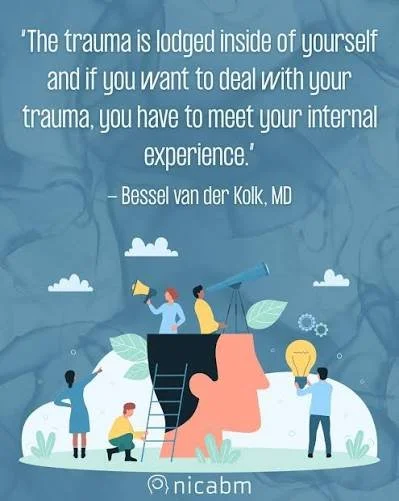
As psychiatrist Bessel van der Kolk (who wrote the book ‘The Body Keeps the Score’) describes it:
[Trauma] is not merely the memory of a past event, but an ongoing physical and neurological imprint that traps the nervous system in a chronic state of fear.
What I’ve come to realise, slowly, and mostly through making Lantern Wood: what the animals actually are, is illustrations of protective parts. Parts of my own psyche, doing their job — protecting something they’ve decided is dangerous.
It also isn’t just decoration. Once I started seeing it that way, a lot of the past few years made a different kind of sense — the paralysis before posting, the endless second opinions, the sudden fascination with a completely different creative direction right when the current one was starting to feel exposing. None of it was a character flaw. It was a system doing exactly what it was built to do.
The place I feel it most clearly is the pull between two of them. There’s Hester, the doe — watchful, still, ready to bolt at the first sign of danger. And there’s Merrin, the squirrel — scattered, striving, gathering and achieving, because surely if he just does enough, that will finally be enough. Between the two of them is basically the whole story: Merrin pushes me to make, to produce, to be productive enough to matter. And then, right at the point where the work would actually be seen — posted, pitched, sold — Hester steps in, and everything stops. It isn’t indecision. It’s a nervous system deciding, in that exact moment, that visibility is the thing to protect against.
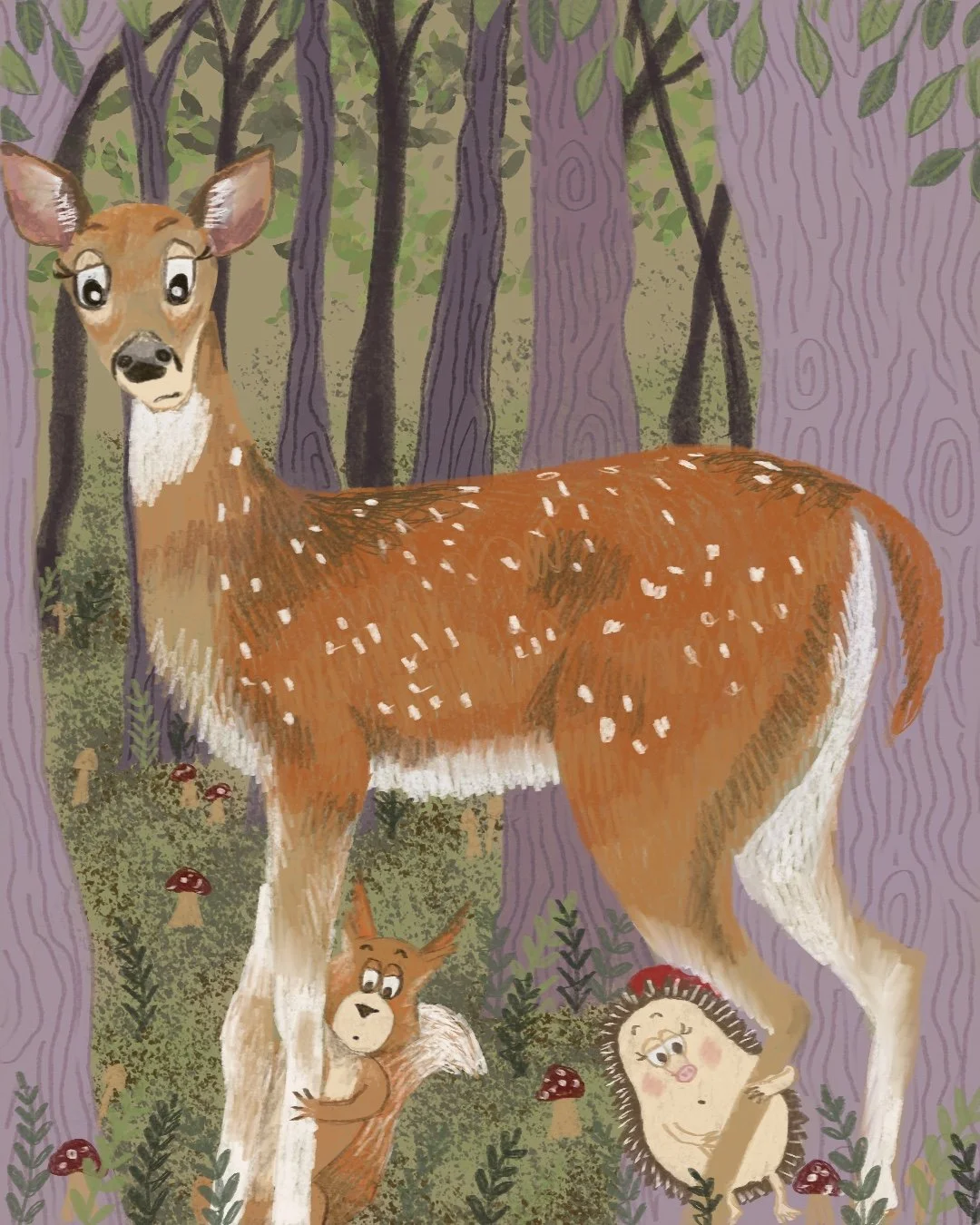
Hester doing what she always does - protecting!
Recently, things came to enough of a head that I’ve gone back into therapy — specifically trauma and attachment-informed EMDR. I’m not going to go into what it’s for; that’s not what this piece is about. But I wanted to say it plainly, because pretending I’d got this fully worked out on my own would be dishonest, and this isn’t a space for that.
“We cannot change anything until we accept it. Condemnation does not liberate, it oppresses.”
— Carl Jung
I think about that a lot in relation to all of this. Not “fix the trauma so you can finally be productive” — just accept that it’s there, so it stops running things from the shadows.
That’s really what this whole project is for. Art helps us move through the hard things, and it can also be exactly where those hard things show up to block us. I’m not writing this as someone who’s got it sorted, handing down five steps to visibility. I’m writing it as someone in the middle of it, who thought it might help to say the quiet part out loud — gently, and hopefully with a bit of humour, because we’re going to need some.
So — if any of this sounds familiar: what does your protective part look like? And what is it protecting?